
Biomarker distributions and compound-specific isotope studies
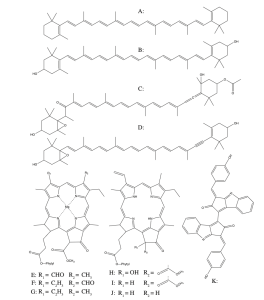
One of the unique tasks of compound-specific isotope studies is attributing a biological source to individual molecules. Most of my interests center on understanding primary producer communities and their response to climate transitions. Chlorophyll and its derivatives are the perfect molecule because the source is linked directly to primary photosynthate. Chlorophylls (I), chlorins (II) and porphyrins (III) are the target molecules for my biomarker and compound-specific isotope studies.
Nitrogen is present in many phases in sediments. Thus, bulk nitrogen isotope data are not likely to always be representative of N derived from primary producer biomass. I worked to isolate primary N-isotopic signals through the isotopic composition of nanomolar quantities of chlorophyll derived porphyrins. These types of analyses, while analytically challenging, provide a measure of specificity that is not possible with bulk analyses alone.
The diversity of chlorophyll and pigments derivatives are also useful as biomarkers and indicators of the redox conditions in the depositional environment; we utilize these data to enhance our understanding of the environment of deposition.
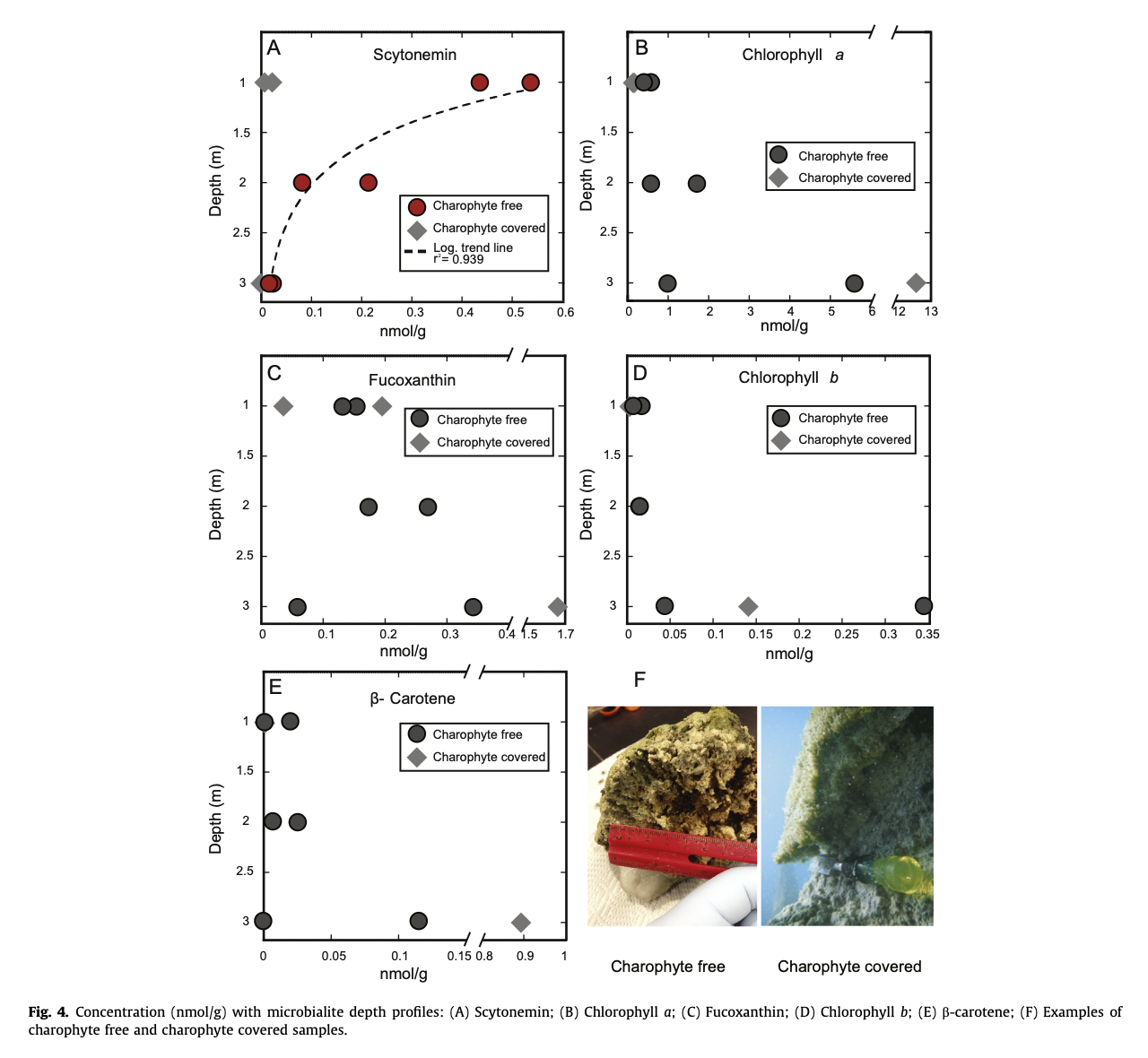
The study above by Uveges et al. (2018) illustrates how photosynthetic communities modulate their pigment production as a response to light levels. Shallow, exposed carbonate microbialites from Green Lake (Fayetteville, NY) contain high abundances of UV screening pigments (scytonemin) at shallow depths and low abundances at deeper water depths. Chlorophyll concentrations increase with depth, as photon fluence decreases with depth. The whole assemblage of pigments provides a clear picture of water depth and light availability, and how it affects pigment production by photoautotrophs.