
Oceanic Anoxic Events 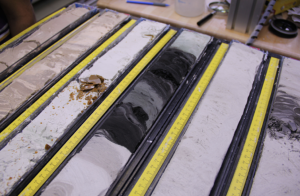 are the byproduct of unique basinal and tectonic characteristics combined with rapid warming that changes the biogeochemical balance in marine environments. The lithologic expression of these events is seen in the expansion of anoxic conditions and the deposition of black shales. The global impact in OAEs on the carbon cycle is seen in signifint changes in the carbon isotope composition of carbonate and organic carbon.
From my dissertation to my current research group, we have worked to understand how the nitrogen cycle in marine environments was impacted by widespread anoxia. OAEs serve as important future Earth scenarios as warming and changes in marine hydrography have already begun to reduce marine oxygen contents.
It is clear that the OAE nitrogen cycle was completely different from any modern analog, an observation that is clearly shown in the nitrogen isotope record from OAEs.
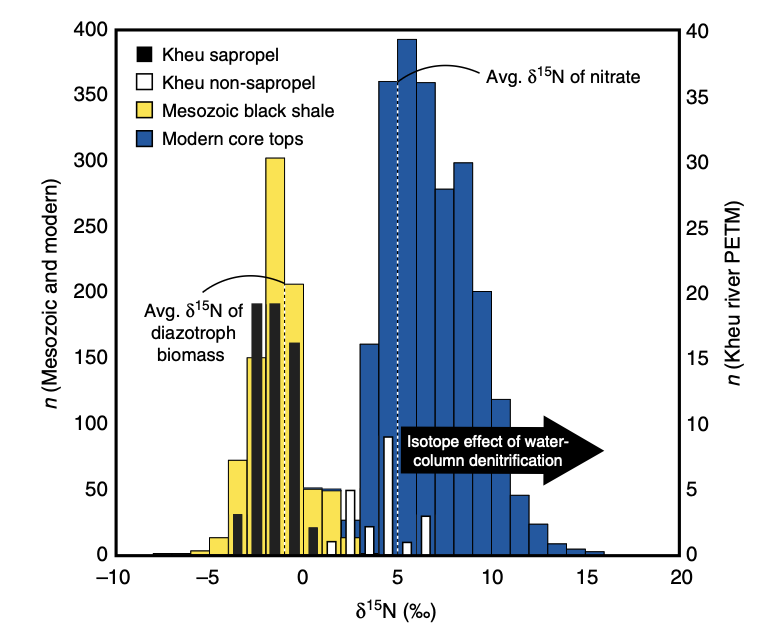
The concepts developed in the Cretaceous apply to intervals of expanded anoxia during the Devonian and Eocene where recent and ongoing work has revealed stereotyped biogeochemical conditions associated with black shale deposition.
Mass Extinctions
While many OAEs are not mass extinctions, many mass extinctions have expanded anoxia and the Late Devonian Kellwasser and Permo-Trassic extinctions are classic examples of OAEs. Mechanisms for extinctions are myriad and a range of environmental perturbations are easily traceable with stable isotope techniques. Sulfur isotopes also reveal the breadth of perturbations to elemental cycling through the progression of mass extinctions.
With collaborators Aubrey Zerkle, Mark Claire, and James Witts we discovered the first instance of atmospherically derived sulfur mass independent fractionation (MIF) in the aftermath of the K-Pg Chicxulub Impact and mass extinction.
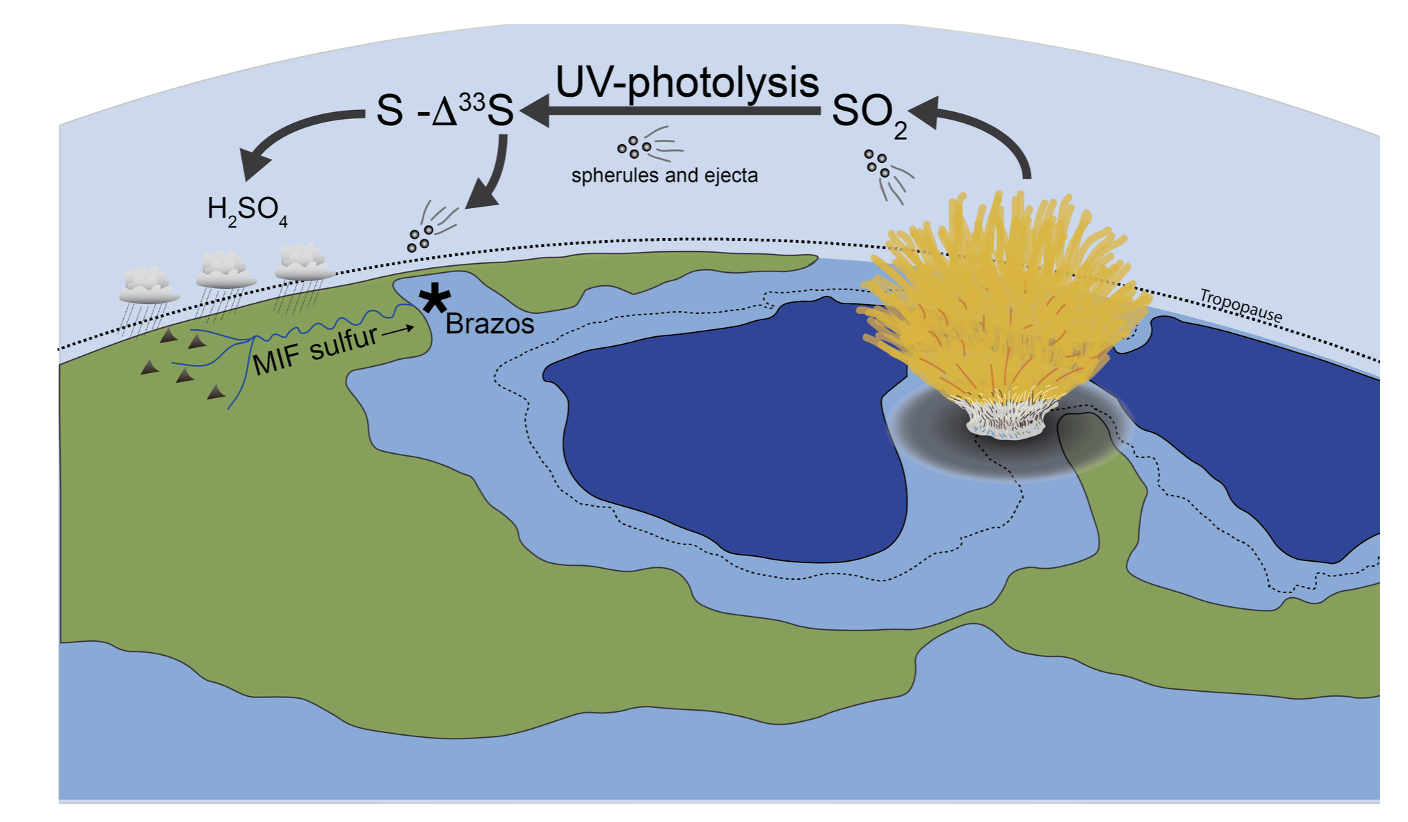
The role of sulfur in the K-Pg mass extinction is well-known, however the extent to which high-altitude, stratospheric sulfur was involved in post-impact climatic upheaval had no empirical basis. The discovery of atmospherically produced sulfur-MIF in marine K-Pg deposits demonstrates the role of sulfur-aerosol induced cooling following the impact. Futhermore, the abundance of sulfur with this signal suggests that the amount of sulfur that was in the stratosphere was large, and the duration of its climatically relevant activity was on the order of decades. Sulfur-induced cooling likely played a central role in the post-impact winter and the extremity of the extinction.
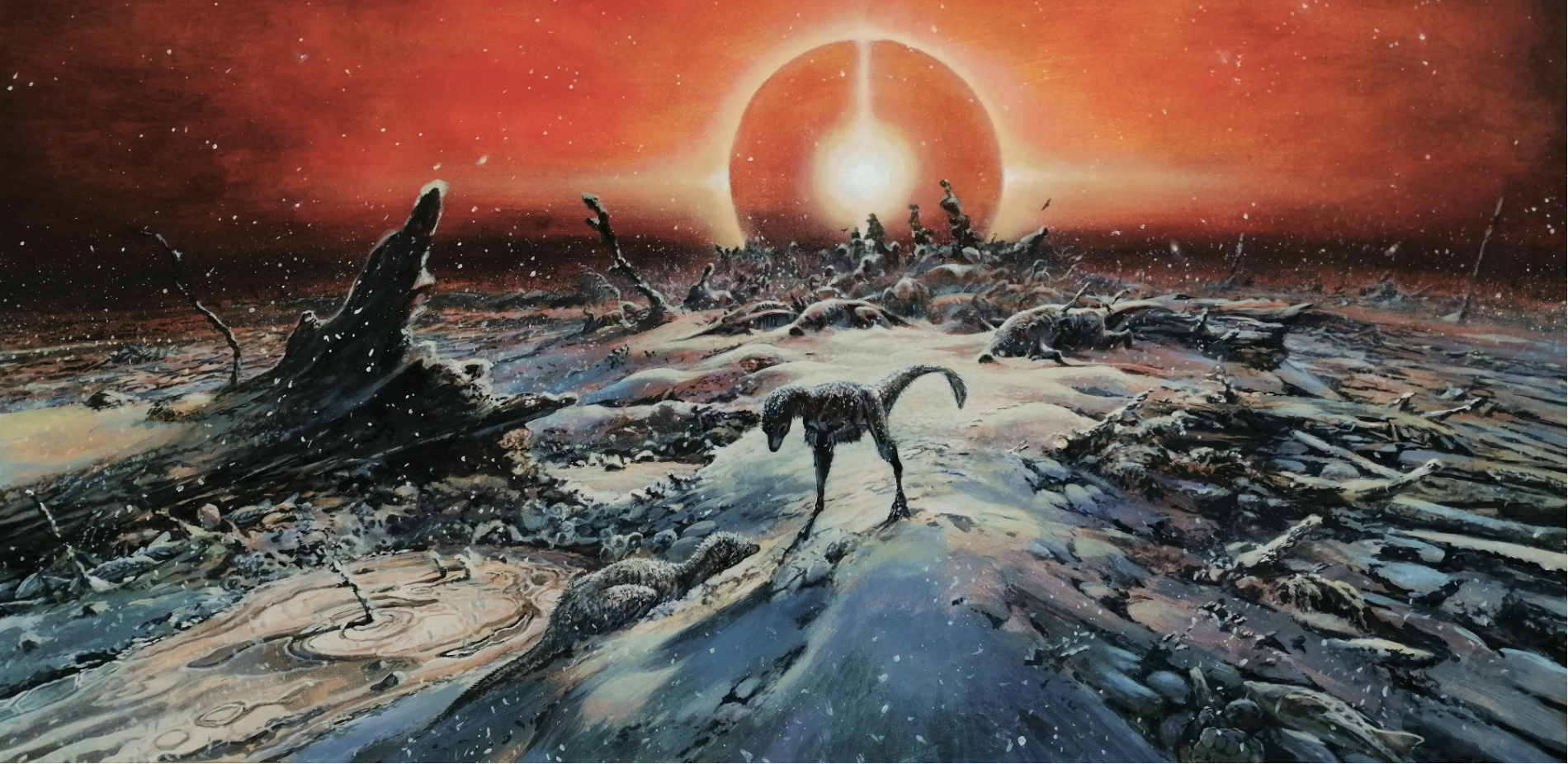
Artist James McKay painted a conception following our S-MIF study. He depicted a pair of juvenile T-Rex struggling in a cold, dark, post-impact winter amongst the detritus of the impact blast and tsunami.
Junium, C.K., Arthur, M.A., (2007) Nitrogen cycling during the Cretaceous, Cenomanian-Turonian Oceanic Anoxic Event II, Geochemistry, Geophysics, Geosystems, 8, 3-19
Junium, C. K., Freeman, K. H., & Arthur, M. A. (2014). Controls on the stratigraphic distribution and nitrogen isotopic composition of zinc, vanadyl and free base porphyrins through Oceanic Anoxic Event 2 at Demerara Rise. Organic Geochemistry, 80, 60-71.
Junium, C.K., Meyers, S.R. and Arthur, M.A., 2018. Nitrogen cycle dynamics in the Late Cretaceous Greenhouse. Earth and Planetary Science Letters, 481, pp.404-411.
Uveges, B.T.*, Junium, C.K., Boyer, D., Cohen, P., Day, J., (2018) Biogeochemical controls on black shale deposition during the Devonian, Frasnian-Famennian Biotic Crisis in the Illinois and Appalachian Basins, USA, inferred from stable isotopes of Nitrogen and Carbon. Paleogeography, Paleoclimatology, Paleoecology, 10.1016/j.palaeo.2018.05.031.
Junium, C.K., Dickson, A.J., Uveges, B.T.*, (2018). Perturbation to the nitrogen cycle during rapid Early Eocene global warming. Nature Communications, 9, pp. 3186.
*Uveges, B.T., Junium, C.K., Scholz, C.A. and Fulton, J.M., 2020. Chemocline collapse in Lake Kivu as an analogue for nitrogen cycling during Oceanic Anoxic Events. Earth and Planetary Science Letters, 548, p.116459.
He, R., Lu, W., Junium, C.K., Ver Straeten, C.A. and Lu, Z., 2020. Paleo-redox context of the Mid-Devonian Appalachian Basin and its relevance to biocrises. Geochimica et Cosmochimica Acta, 287, 328-340.
Junium, C.K., Zerkle, A.L., Witts, J.W., Ivany, L.C., Yancey, T., Liu, C., Claire, M.W. (2022) Massive perturbations to atmospheric sulfur in the aftermath of the Chicxulub impact. Proceedings of the National Academy of Science, 119(14), p.e2119194119.