
Nano-EA-IRMS
The centerpiece of the GAPP lab is the nano-EA. The nano-EA marries a conventional gas-source isotope ratio mass spectrometer with a modified elemental analyzer that is coupled to a gas bench. Sample gas from the elemental analyzer is cryogenically trapped and capillary-focused resulting in a significant increase in sample utilization by the IRMS, allowing for significantly smaller samples than conventional EA-IRMS (2-3 orders of magnitude). This approach is excellent for when materials are extremely limited (e.g. compound specific analyses) or when the sample combustion process benefits from smaller amounts of material to optimize analysis (e.g. thermally mature kerogens). We have analyzed materials from single organic-walled microfossils for carbon isotopes, shell-associated nitrogen isotopes, kerogens and other carbonaceous materials for carbon and nitrogen isotopes, non-volatile organic compounds like chlorophyll derivatives, and any material with extremely low C and N contents.
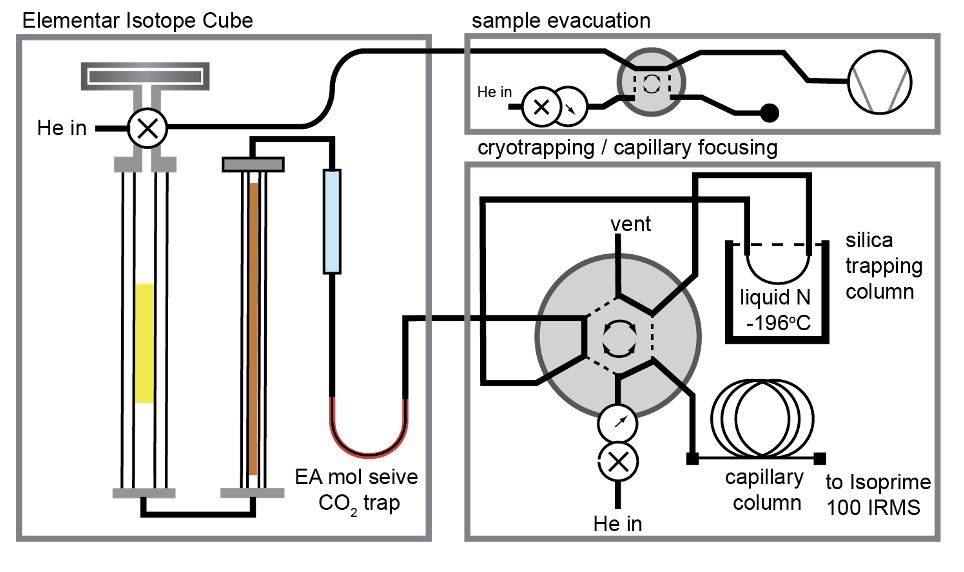
We are open to outside collaboration, but do to the intensive nature of the nano-EA we generally do not accept samples on a pay per-sample basis.
Working with small amounts of solids we use in the nano-EA opens the possibility of contamination from airborne particulates, especially human-derived nitrogen and carbon containing particles. This space is designed to minimize particulates the could contaminate samples at the end stages of sample prep such as loading into capsules immediately prior to isotopic analyses.
Class 10,000 Clean Chemistry Lab
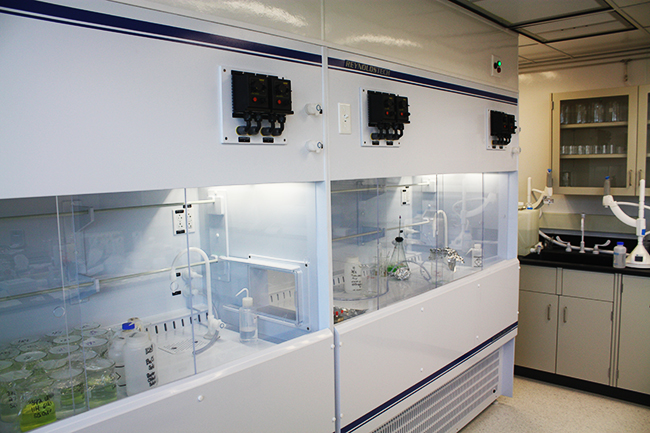
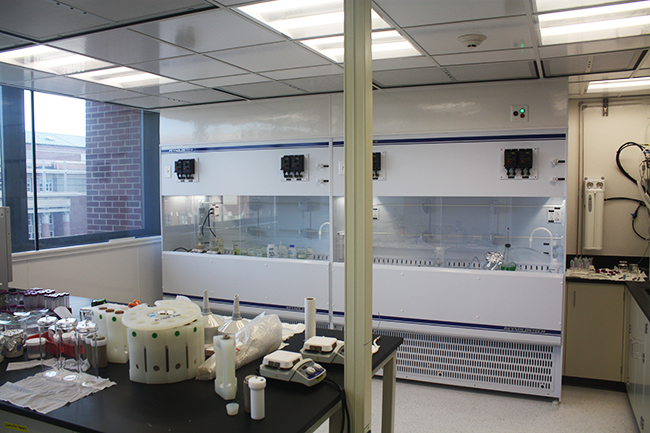
This lab features two SU Patented Class 10 Isolation Cabinets designed by Kevin Noble of SU’s Office of Planning Design and Construction and custom manufactured by Reynolds Tech Fabricators here in the Syracuse area.
Instrumention Lab
The lab space is shared with Professor Tripti Bhattacharya houses three mass spectrometers that provide broad capabilies in stable isotope and organic geochemistry.
- IsoPrime 100 stable isotope ratio mass spectrometer coupled to an Elementar Isotope Cube elemental analyzer and a TraceGas headspace gas analyzer. The EA and TraceGas have been reconfigured into a nano-EA that is capable of analyzing nanomolar quantities of solids for their carbon and nitrogen isotope composition. The instrument lab is also served by HEPA filtered air that minimizes dust and maintains constant temperatures.
- Thermo Delta V coupled to a gas chromatograph/combustion module is used for compound-specific carbon, nitrogen and hydrogen isotope analyses on volatile hydrocarbons.
- A Thermo LCQ Fleet liquid-chromatography (Ultimate 3000 with diode array), ion trap mass spectrometer for the identification and quantification of pigments and non-volatile lipids.
Images from inside the Class 10,000 Clean Instrument Lab
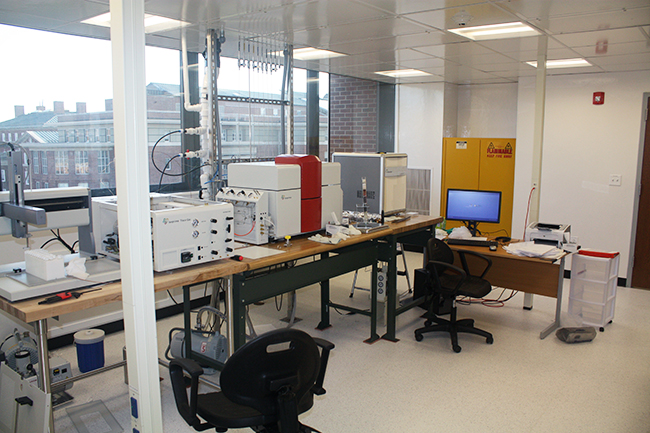
Pictured above is the Isoprime 100 stable isotope mass spectrometer and nano-EA peripherals.
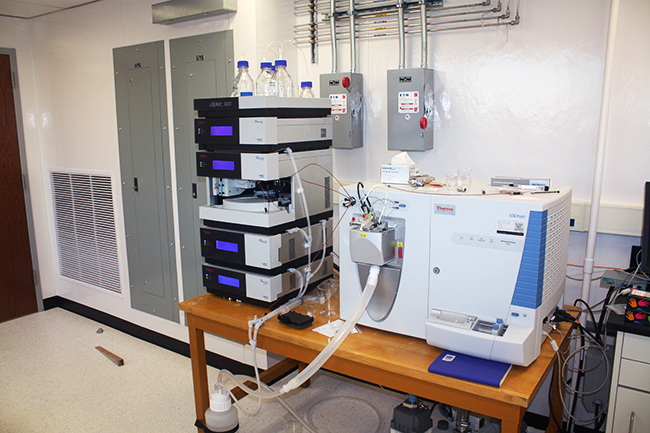
Pictured above is the Thermo LCQ Fleet ion trap mass spectrometer with the Ultimate 3000 UHPLC.